Which MTG API? Scryfall vs MTGJSON vs Daily Prices (2026)
Scryfall has no price history; MTGJSON ships bulk snapshots. What each Magic: The Gathering API actually covers — card data, images, and daily pricing.
For Magic: The Gathering card data, Scryfall is the default — free, comprehensive, and the richest source of oracle text, rulings and images, with a daily price snapshot per finish. MTGJSON adds bulk price history if you can host a 150 MB download. Neither offers per-condition pricing or change tracking.
Building a Magic: The Gathering app? You need card data, and there are several APIs to choose from. Each one has different strengths — some focus on card metadata, others on images, and others on pricing.
This guide covers every major MTG API available in 2026, what each does best, and how to pick the right one for your project.
Why Developers Need MTG APIs
The Magic: The Gathering ecosystem is massive. Over 27,000 unique cards across 30+ years of sets, multiple printings of the same card, foils, alternate art, and prices that fluctuate daily. Manually maintaining this data is impossible.
Common use cases for MTG APIs include:
- Deck builders — Card search, mana costs, oracle text, legality
- Collection managers — Track what you own and what it’s worth
- Price trackers — Monitor market values and find deals
- Store tools — Inventory management, price comparisons
- Analytics — Metagame analysis, price trends, set EV calculators
No single API does everything perfectly. Here’s what each one brings to the table.
Scryfall
Scryfall is the most popular MTG API and for good reason. It has excellent card data, high-quality images, and a well-designed API.
What it offers:
- Complete MTG card database with oracle text, rulings, and legality
- High-resolution card images (normal, art crop, border crop, etc.)
- Fuzzy name matching and full-text search
- Bulk data downloads (JSON dumps updated daily)
- Price data sourced from TCGPlayer, Cardmarket, and Cardhoarder
Limitations:
- Magic: The Gathering only — no Pokemon, Yu-Gi-Oh!, or other games
- Pricing is a single daily snapshot per finish — no per-condition breakdown
- No historical price data or price change tracking
- Rate limit: 10 requests per second (generous but no paid tier for higher limits)
Best for: Deck builders, card databases, and apps that need rich card metadata and images.
// Scryfall example: search for a cardconst response = await fetch( 'https://api.scryfall.com/cards/named?fuzzy=lightning+bolt');const card = await response.json();console.log(card.name); // "Lightning Bolt"console.log(card.prices.usd); // "1.23"MTGJSON
MTGJSON takes a different approach — instead of a REST API, it provides downloadable JSON files containing the entire MTG card database.
What it offers:
- Complete MTG card and set data in JSON format
- Regularly updated bulk downloads
- Detailed card metadata including foreign language printings
- TCGPlayer and Cardmarket price data in separate downloads
- Open source
Limitations:
- Bulk downloads only — no REST API for individual queries
- You need to host and index the data yourself
- Magic: The Gathering only
- Pricing arrives as bulk snapshots on MTGJSON’s build cadence, not per request
- No search functionality — you build that yourself
Best for: Projects that need complete offline data, custom search engines, or want to avoid API rate limits by hosting the data locally.
magicthegathering.io
magicthegathering.io is one of the original MTG APIs. It provides a straightforward REST API for card data.
What it offers:
- REST API with card search and filtering
- Basic card data (name, text, colors, types)
- No authentication required
Limitations:
- Deprecated/unmaintained — data updates have been inconsistent
- No pricing data
- Missing newer sets
- Magic: The Gathering only
- Slower response times compared to alternatives
Best for: Legacy projects already using it. For new projects, Scryfall or TCG API are better choices.
Gatherer and MTG Arena
Two things people search for constantly that are worth addressing directly, because the answer in both cases is “not the way you are hoping”.
Gatherer
Gatherer is Wizards of the Coast’s official card database — the canonical source for oracle text and rulings, with a web interface and no developer documentation alongside it.
You mostly do not need one, because Gatherer’s identifiers are already in the
other APIs. A card object from magicthegathering.io includes a multiverseid
field, and Scryfall carries a multiverse_ids array — both are Gatherer’s own
identifier, so you can link straight back to a card’s Gatherer page:
https://gatherer.wizards.com/Pages/Card/Details.aspx?multiverseid=191089That legacy URL still works, though it now redirects to Gatherer’s newer
slug-based format (/VMA/en-us/4/black-lotus and similar), so follow redirects
rather than parsing the response URL.
One trap worth knowing: Scryfall’s multiverse_ids is an array, and it is
empty for printings Gatherer has no entry for. Checked on 26 August 2026,
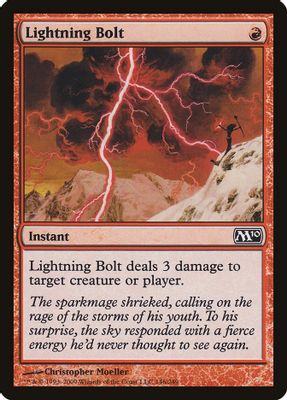
Lightning Bolt returned [191089] for M10, [209] for Alpha and [806] for
Unlimited — but the default printing returned by /cards/named came back with
[]. Do not assume the field is populated; request the specific printing you
mean, and handle the empty case.
If you were searching for “the Gatherer API”, what you actually wanted was Scryfall or magicthegathering.io plus that ID.
MTG Arena
None of the APIs in this guide expose MTG Arena data — not your Arena collection, not your match history, not Arena-specific card availability or wildcard costs. Scryfall, MTGJSON and magicthegathering.io are all paper-card data sources, and TCG API prices physical cards from a physical marketplace. Arena digital objects have no market price at all, so there is nothing for a pricing API to return.
Tools that read Arena collections generally parse the game client’s local log files on your own machine rather than calling any API. That is a fundamentally different approach, and if that is your project, none of the options on this page will help.
MTGGoldfish
MTGGoldfish is one of the best-known Magic price and deck sites — metagame breakdowns, budget deck lists, price movers and set reviews. If you follow Magic finance at all, you already read it.
It does not publish a public API. There is no developer documentation and no API
endpoints are advertised on the site — /api, /docs, /developers and /api-docs all
return 404, while an ordinary missing page returns 404 too, so the site does report
missing routes correctly (checked August 2026). If you came here searching for
“MTGGoldfish API”, that is why you could not find one.
For programmatic Magic pricing you need one of the options above: Scryfall for a daily snapshot per finish, MTGJSON for bulk downloads, or TCG API for per-printing prices with history and 24h/7d/30d change tracking.
TCG API
TCG API focuses on what the other APIs lack: price history and change tracking, across multiple games.
What it offers:
- Market pricing from TCGPlayer — refreshed daily for Magic and the other top games, every ~3 days catalog-wide
- 57 games including Magic, Pokemon, Yu-Gi-Oh!, Lorcana, Flesh & Blood, One Piece, and more
- Normal and Foil prices tracked separately
- Price change data (24h, 7d, 30d)
- Card search with filtering by game, set, and name
- Price movers endpoint (biggest gainers and losers)
- Bulk price data endpoints (Pro tier and above)
Limitations:
- Focused on pricing — card metadata is less detailed than Scryfall for MTG-specific fields (oracle text, rulings, legality)
- No card images hosted (provides TCGPlayer product URLs)
- Requires API key (free tier: 100 req/day)
Best for: Price tracking, collection valuation, store tools, and any project that needs pricing across multiple TCGs.
// TCG API example: get Magic card pricesconst API_KEY = 'your-api-key';const response = await fetch(  'https://api.tcgapi.dev/v1/search?q=lightning+bolt&game=magic&per_page=3',  { headers: { 'X-API-Key': API_KEY } });const data = await response.json();
// /v1/search returns one flat row per card, with its lowest-priced printingdata.data.forEach(card => {  console.log(`${card.name} (${card.set_name})`);  console.log(`  ${card.printing}: $${(card.market_price ?? 0).toFixed(2)}`);});
Feature Comparison
Here’s how the APIs stack up across key features:
Card Data & Search
- Scryfall — Excellent. Full oracle text, rulings, legality, fuzzy search
- MTGJSON — Excellent data, but no search API (bulk download only)
- magicthegathering.io — Basic card data, outdated
- TCG API — Good card data, full-text search with game/set filters
Card Images
- Scryfall — High-res images in multiple crops
- MTGJSON — No images (links to Scryfall/Gatherer)
- magicthegathering.io — Basic images
- TCG API — Links to TCGPlayer product pages
Pricing
- Scryfall — Daily snapshot per finish, no history or change tracking
- MTGJSON — Bulk snapshots on their build cadence
- magicthegathering.io — None
- TCG API — Daily market prices with 24h/7d/30d changes and full history
Multi-Game Support
- Scryfall — MTG only
- MTGJSON — MTG only
- magicthegathering.io — MTG only
- TCG API — 57 games (Pokemon, Yu-Gi-Oh!, Lorcana, etc.)
Rate Limits
- Scryfall — 10 req/sec (free, no paid tier)
- MTGJSON — N/A (bulk download)
- magicthegathering.io — Varies (unreliable)
- TCG API — 100 req/day free, up to 50K/day on paid plans
When to Use Each API
Use Scryfall when you’re building a deck builder, card database, or any app where rich MTG card metadata (oracle text, rulings, legality) is the priority. Scryfall is the gold standard for MTG card data.
Use MTGJSON when you want to host the data yourself, need offline access, or are building a custom search engine. Great for apps that need the full card database without making API calls.
Use TCG API when pricing is important to your project. If you’re building a collection tracker, price alert system, store tool, or anything that needs to know what cards are worth — and especially if you want to support multiple games beyond just Magic — TCG API is the right choice.
Combine them for the best of both worlds. Many developers use Scryfall for card data and images alongside TCG API for pricing. The APIs complement each other well.
Getting Started with TCG API for Magic
Here’s a quick example that fetches the most valuable Magic cards from a specific set:
const API_KEY = 'your-api-key';const BASE_URL = 'https://api.tcgapi.dev/v1';
// Set endpoints take the numeric set id, so look it up firstasync function getSetId(gameSlug, setSlug) {  const res = await fetch(`${BASE_URL}/games/${gameSlug}/sets?per_page=100`, {    headers: { 'X-API-Key': API_KEY }  });  const { data } = await res.json();  return data.find(s => s.slug === setSlug)?.id;}
async function getSetPrices(setId) {  const response = await fetch(    `${BASE_URL}/sets/${setId}/cards?sort=price_desc&per_page=10`,    { headers: { 'X-API-Key': API_KEY } }  );  const data = await response.json();
  console.log('Top 10 Most Valuable Cards:\n');  data.data.forEach((card, i) => {    console.log(`${i + 1}. ${card.name} — $${(card.market_price ?? 0).toFixed(2)}`);  });}
const setId = await getSetId('magic', 'foundations');await getSetPrices(setId);
For a deeper dive into building with TCG API, check out:
- Quickstart Guide — Make your first API call in 2 minutes
- Search API Reference — Full-text search with filters
- Price Data — Price endpoints and movers
- Magic: The Gathering on TCG API — All MTG sets and data
- Scryfall Comparison — Detailed side-by-side breakdown
- Yu-Gi-Oh! API Guide — The same breakdown for Yu-Gi-Oh!
- Card API Endpoint Reference — Exact payload
fields and download URIs for Scryfall’s bulk files and MTGJSON’s
AtomicCards.json, checked live
Get Started
Ready to add pricing to your Magic project? Sign up for a free TCG API key and follow the quickstart guide. The free tier gives you 100 requests per day to test with, and paid plans start at $9.99/month when you need more.
Questions about choosing the right API? Join us on Discord — we’re happy to help you figure out the best stack for your project.
Ready to get started?
Free tier includes 100 requests per day. No credit card required.